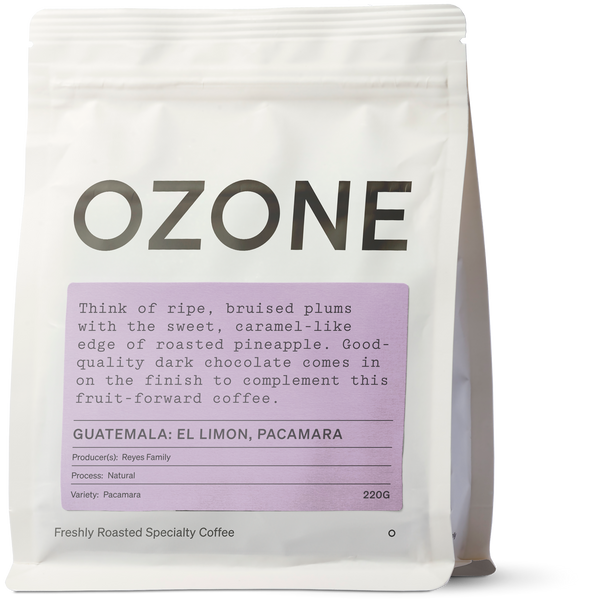
This is In My Mug coffee number 941, roasted and posted to subscribers on Friday 20 November 2026.
Think of ripe, bruised plums with the sweet, caramel-like edge of roasted pineapple. Good-quality dark chocolate comes in on the finish to complement this fruit-forward coffee.
Back to Palencia
There’s something satisfying about a natural Pacamara from San Patricio El Limón turning up in the IMM line-up. It’s the coffee the Reyes family are best known for, and it’s become a regular feature of the series. If you were with us for IMM 845 or IMM 908, you’ll know what to expect: big fruit, plenty of sweetness, and a cup that changes a little from year to year. A month ago we had the family’s natural Caturra in IMM 937. This week we’re back with another of this season’s lots, and it’s the variety that made their name.
El Limón sits in the hills of Palencia, a short drive east of Guatemala City, on volcanic soil between 1,350 and 1,850 metres above sea level. It’s been in the family since 1997, and these days it’s very much a team effort across two generations. Beto’s wife Marilyn and their children Eliana, Betio, Saul and Ruth each look after their own part of the business, several of them bringing training in agricultural science back to the farm. Decisions are made together, and Beto’s brother Felix runs the mill.
We’ve been buying from the family since 2013, when they became the first producers we ever bought from directly in Guatemala, and in that time we’ve watched Beto’s experimental streak really take hold. The farm was built on Caturra and Bourbon, but it now grows SL28, H1, H3, Maracaturra, Maragogype, Geisha, both yellow and red Catuaí, and of course the Pacamara in your mug this week.
Meet the Pacamara
Pacamara was created in El Salvador in 1958 by the Salvadoran Institute for Coffee Research (ISIC), which crossed Pacas, a compact Bourbon mutation discovered on the Pacas family’s farm in Santa Ana, with Maragogype, a giant Typica mutation first identified in Bahia, Brazil. The aim was to combine Pacas’s compact, productive growth with Maragogype’s size and cup quality, and several generations of careful selection followed before the variety was released to farmers.
The result is a plant with huge leaves, cherries and beans, and a cup that can take in tropical and stone fruit, citrus, florals and spice, with lots of sweetness and a creamy texture. It keeps growers on their toes, too. Not every seedling breeds true, so they select their plants carefully in the nursery, and lots can differ widely from one farm to the next. You can read more in our Pacamara varietal guide.
From cherry to cup
With a natural, the whole cherry is dried with the bean still inside, so the drying stage shapes the cup more than almost anything else. We’ve seen this first hand with natural Pacamara elsewhere. At Finca Limoncillo in Nicaragua, simply changing how often the drying coffee was turned gave two very different lots from the same harvest, one clean and elegant, the other wild and funky.
At El Limón, that control comes from processing their own coffee at the family’s mill. It’s a busy one, too. Neighbours from across Palencia bring their coffee there to be processed. For more on how naturals work, take a look at our coffee processing guide.
A winning combination
Natural Pacamara has done more than anything else to put El Limón on the map. In 2021 one placed 14th in the Guatemala Cup of Excellence with a score of 88.01. In 2025 another finished 8th in the naturals category, scoring 88.38. That same year, a natural Pacamara from El Limón took 2nd place in the Natural category of Flores del Café, a competition organised by Anacafé and IWCA Guatemala for coffees produced by women, with a score of 88.25.
The coffee in your bag this week is this season’s natural Pacamara from the farm: same variety, same process, grown on the same slopes.
Big beans, different rules
Pacamara’s size changes how the coffee behaves at every stage after it leaves the farm.
In the roaster, heat takes longer to reach the centre of a bean this big. Push too hard and the outside can race ahead while the middle lags behind. Pacamara also tends to look lighter in colour than it tastes, so we judge the roast on the cupping table rather than by eye. This year we’ve taken it to medium-dark, carrying it steadily through the gap and up to the cusp of second crack, sometimes just a pop or two, which gives the cup real depth to sit alongside all that fruit.
Size matters in your grinder too. Pacamara beans are big and a little less dense than most coffees, so they can break up differently. At your usual setting they might grind slightly coarser than you’d expect, and water can run through faster than normal. If your brew or shot finishes quicker than usual, or the cup tastes a bit sour or hollow, try going a notch finer. If it turns bitter or drying, back off a step.
It’s worth weighing your coffee rather than scooping it this week. A scoop of beans this big can hold noticeably less coffee than a scoop of something smaller, and if you’re making espresso, your usual dose may sit differently in the basket.
Read more about the family in our producer story on the Reyes family.
Traceability
- Country: Guatemala
- Region: Palencia
- Farm: San Patricio El Limón
- Producers: The Reyes family
- Altitude: 1,350 to 1,850 m.a.s.l.
- Farm size: 18 hectares
- Coffee growing area: 9 hectares
- Varietal: Pacamara
- Processing method: Natural
Cupping scores
Tasting notes: Bruised plum, dark chocolate, roasted pineapple.
Cup of Excellence cupping scores
- Clean cup: 6.5/8
- Sweetness: 6.5/8
- Acidity: 6/8
- Mouthfeel: 6.5/8
- Flavour: 6.5/8
- Aftertaste: 6/8
- Balance: 6/8
- Overall: 6.5/8
- Correction: +36
- Total: 86.5/100
If you’d like to find out more about how we score coffees, make sure to read our blog post “What Do Coffee Cupping Scores Actually Mean?” and if you’d like to try cupping yourself, we’ve got a guide to that too! What is Coffee Cupping.
Roast information
Medium-dark
Push this steadily through the gap and up to the cusp of second, maybe just a pop or two as you finish the roast.